- Hard Titleប្លង់រឹងNationally registered ownership certificate issued by the MLMUPC. The strongest, most secure form of property ownership in Cambodia.
- Soft Titleប្លង់ទន់Locally registered possession document, certified at commune or district level. Common but legally weaker than hard title — can be overruled by a conflicting hard title.
- Strata Titleប័ណ្ណកម្មសិទ្ធិសហកម្មសិទ្ធិករHard-title-grade certificate for individual units in co-owned buildings. The only direct ownership path available to foreigners under Cambodia's 2010 co-ownership law.
- LMAP TitleVariant of hard titleA hard title issued through the World Bank–supported systematic land registration program. The basis for the modern hard title system — same legal strength.
Why Cambodia has three types of property title.
To understand why Cambodia's property title system is the way it is, you have to understand the country's history. Cambodia's land titling system is not complicated by accident — it is complicated by history, specifically by a period of deliberate destruction that set the entire country's property records back to zero.
Between 1975 and 1979, the Khmer Rouge abolished private property ownership entirely and destroyed virtually all official property records. All land was declared state property. After the fall of the regime, Cambodia spent another decade with property ownership unrecognized. Private land ownership was legally restored in 1989, but the modern framework only took shape with the 2001 Land Law, which established the national cadastral system and created the legal distinction between possession (soft title) and registered ownership (hard title). Strata title for foreign ownership followed in 2009–2010 via Sub-Decrees No. 126 and No. 82. Throughout the 2000s and 2010s, systematic registration was rolled out province by province — including under the World Bank–supported LMAP program from 2002 — and as of 2026, the MLMUPC has launched verify.gov.kh for instant QR-code title verification.
All land records destroyed. Private ownership eliminated entirely. All land declared state property.
Cambodia's first post-Khmer Rouge Land Law re-establishes private ownership rights. Informal possession documentation begins to emerge.
Cambodia issues a revised Land Law establishing a formal national land registration system. This created the legal framework for hard titles.
Cambodia passes legislation allowing foreigners to own condo units via strata title. First legal pathway to direct foreign property ownership in Cambodia.
Millions of parcels have been brought into the national cadastral system. Soft titles remain prevalent but hard titles are becoming the standard across urban areas.
The 2001 Land Law is still the foundation of modern Cambodian property rights, and that distinction between possession and registered ownership is the whole game when understanding titles today.
21 of 25 provinces have completed nationwide land registration. The rest finishes by 2027.
The MLMUPC has confirmed that systematic land registration is complete in 21 of Cambodia's 25 provinces. Only parts of Phnom Penh, Ratanakiri, Koh Kong, and Kampot remain — all targeted for completion by end of 2027. Once finished, every parcel in the country will be in the national cadastre, dramatically reducing dispute risk and shrinking the soft-title market over time.
Concentrate your purchases in hard or strata title.
With nationwide hard-title coverage on the horizon, soft-title properties will increasingly be the exception rather than the norm — and their resale liquidity will reflect that. For any meaningful investment in 2026 onward, hard title (for land and landed property) or strata title (for condos) is the conservative default. Soft title still has its place, but with a clear conversion plan attached.
Hard title: what it is and why it matters.
Hard title (ប្លង់រឹង) is the highest form of property ownership recognition in Cambodia. It is an ownership certificate issued by the Ministry of Land Management, Urban Planning, and Construction (MLMUPC) and recorded in the national cadastral system — the official national land register.
A nationally registered land ownership certificate recorded in Cambodia's cadastral system. The strongest, most widely accepted form of property ownership in Cambodia.
Hard title is the only document that gives you full, indisputable ownership as recognized by the national government. The modern version includes a QR code that links to the national registry, showing the land's location, dimensions, size, and registered owner — all verifiable in real time.
When land goes through systematic registration to achieve hard title status, it passes through a mandatory public display period (typically 30 days), during which cadastral maps and owner lists are posted publicly for inspection and objections. This process is specifically designed to surface and resolve disputes before the registration is finalized — which is one of the key reasons hard title is far more reliable than soft title.
Hard title is required for bank mortgages. It allows for national-level disputes to be resolved definitively. It is the form of title that courts will recognize with the least ambiguity.
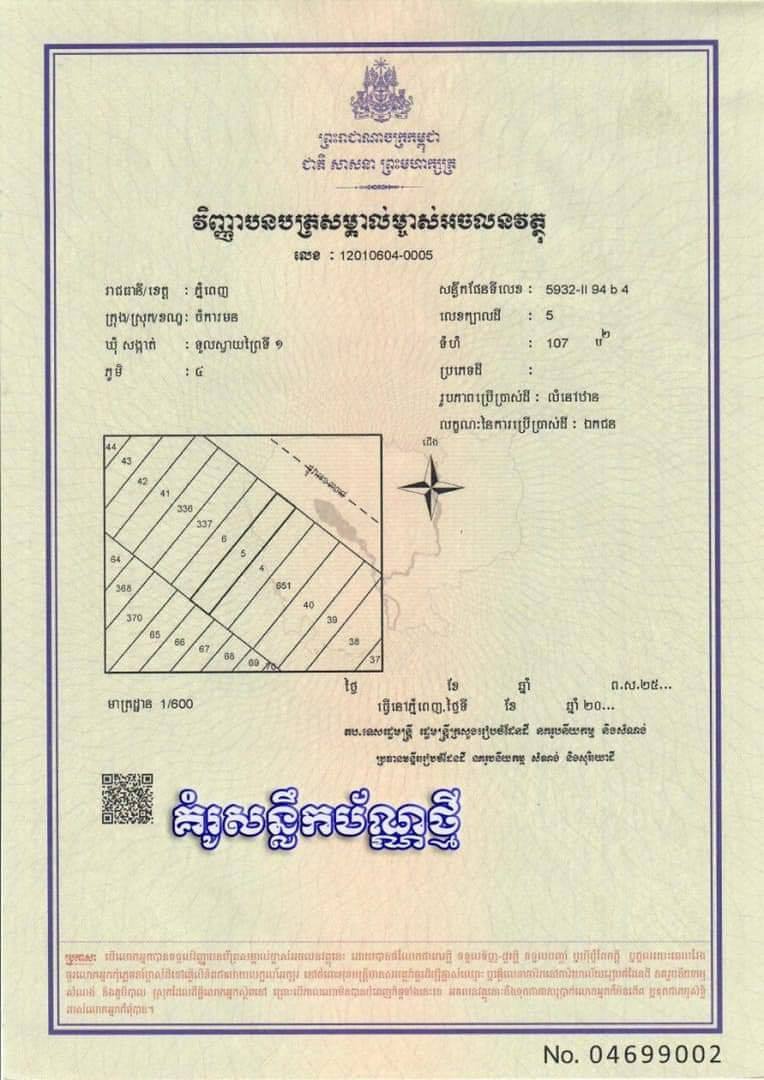
What makes hard title verifiable
The new generation of hard title certificates includes a QR code. Scanning it gives you the land's GPS coordinates, plot dimensions, registered area, and the current registered owner's name — directly from the Ministry's database. This makes verification simple and forgery significantly harder. We cover the full verification process in the How to verify a property title section below.
Always verify, even if the title looks genuine.
A hard title on paper is only as good as the registry check behind it. In rare cases, a property may carry both a hard title and older soft title documentation — meaning the soft title holder may not know their claim was superseded. Confirm with the Ministry before signing anything.
Hard title and borey purchases
Most reputable borey developers deliver hard title to buyers, either at handover or within a defined window afterward. The developer holds a master hard title over the entire development, which gets subdivided into individual plot titles as each unit is sold and transferred. This is why boreys are the recommended entry point for first-time buyers — the title process is handled by the developer rather than navigated independently by the buyer.
Ready to run the numbers on a hard-title mortgage?
Hard title unlocks bank financing. Use our mortgage calculator to estimate monthly payments, then compare rates across Cambodian banks in the bank directory.
Soft title: what it means, and the risks to understand.
Soft title (ប្លង់ទន់) is what developed as the practical working system in Cambodia before — and during — the gradual national land registration process. It is locally registered documentation that recognizes your possession of land, but it is not the same thing as nationally registered ownership.
Locally registered proof of possession certified at the commune (sangkat) or district (khan) level. Not recorded in the national cadastral system. Under Cambodia's Land Law, it is evidence of possession, not indisputable ownership.
The critical legal distinction is this: Cambodia's 2001 Land Law explicitly defines a possession title as evidence of possession, not indisputable evidence of ownership. This difference matters enormously in a dispute.
Soft title is issued by local government — commune (sangkat) offices and sometimes district (khan) offices. It is not registered in the national cadastral system. As a result, it is not visible to other parties checking the national registry, and it can be overruled by a conflicting hard title.
Soft titles are not fraudulent documents. They are a legitimate part of the Cambodian property system, and millions of transactions have been successfully conducted using them. But they carry inherent risks that a buyer needs to understand before proceeding — particularly for larger purchases or long-term holds.
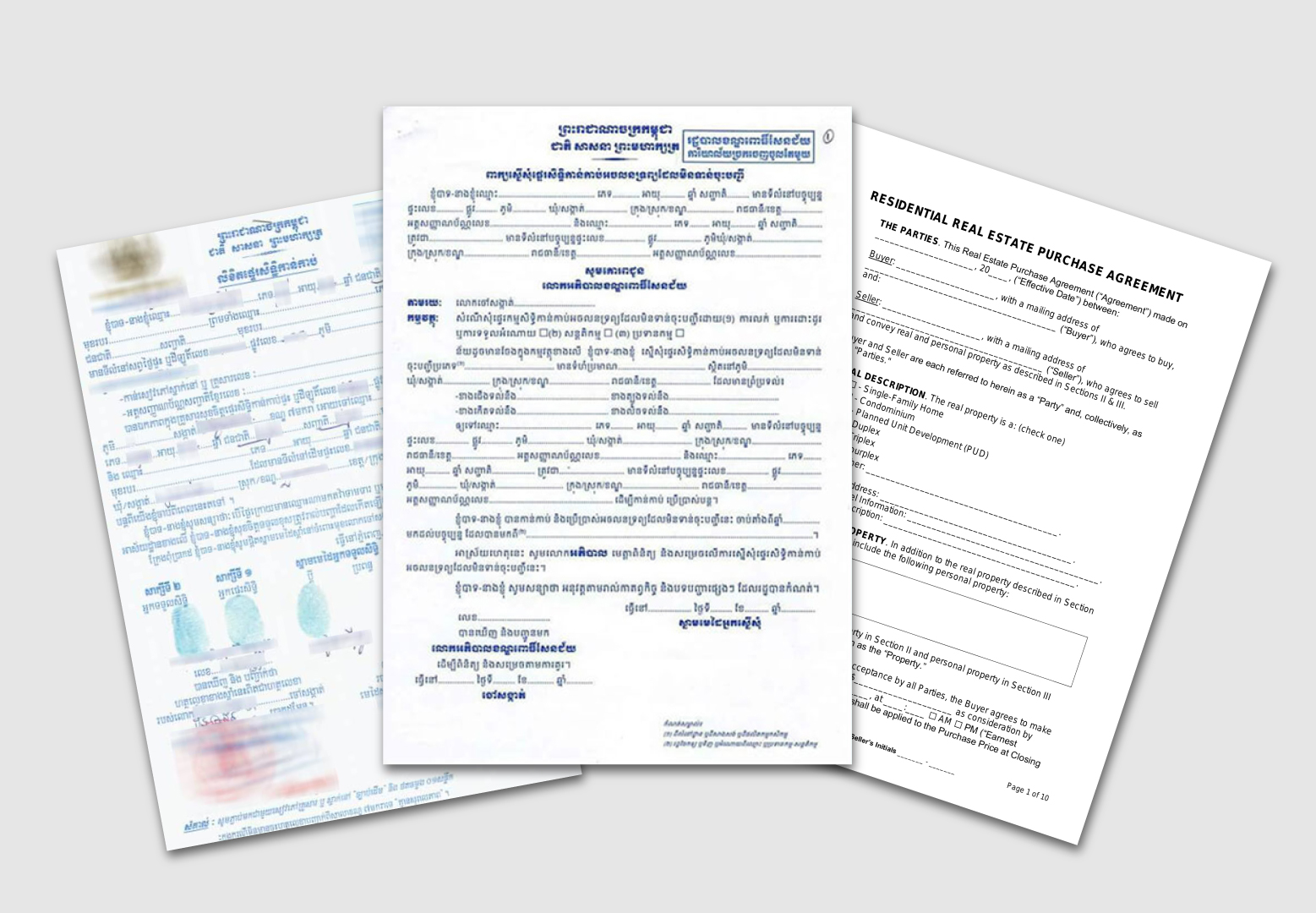
The specific risks of soft title
A conflicting hard title can overrule your soft title.
If a hard title exists (or is later issued) on the same parcel, the hard title holder wins. This is the most serious risk — your possession documentation becomes legally secondary to registered ownership.
Boundary ambiguity is common.
Soft title parcels may not have undergone the full survey and public adjudication process that hard title requires. Boundaries can be imprecisely defined, leading to overlaps with neighboring plots that are only discovered years later.
You cannot easily get a bank mortgage.
Cambodian commercial banks require hard title as collateral for property mortgages. Soft title transactions are typically cash-only or developer-financed — limiting your options and often requiring more capital upfront.
Soft title is not in the national registry — meaning it's invisible to a national check.
When someone conducts a national-level title search on a parcel, your soft title ownership will not appear. A buyer doing due diligence through national channels will see a clean record — even if you've held the property for years.
Resale can be harder and pricing is discounted.
Buyers willing to purchase soft-title property typically expect a price discount versus an equivalent hard-title parcel. The resale market is narrower — no bank financing means fewer potential buyers.
When soft title may be acceptable
Soft title is not automatically a dealbreaker, but it requires a conscious decision about risk. Scenarios where experienced buyers sometimes proceed with soft title:
- Short-term holds with a clear conversion plan. If you intend to renovate and resell quickly, and you've verified the conversion pathway to hard title is available and straightforward for that parcel, the lower price point of soft title may make sense.
- Lower-value rural land where the national registration process has not yet reached.
- After thorough verification of local ownership history, boundary clarity, and confirmation from neighbors that no conflicting hard title exists in the area.
For a first-time buyer making a significant purchase, and especially for anyone financing through a bank, soft title is not recommended as a target — it's a constraint to work around, ideally by converting it before or as part of the transaction.
"Soft title" is a category, not a single document.
The phrase "soft title" covers a range of local documentation — sale agreements, possession letters, commune-certified measurements, and others. Experienced agents and lawyers treat it as a category that requires verifying what's actually there. Never assume two soft-title properties carry equivalent risk without examining the specific paperwork.
Strata title: the only direct ownership path for foreigners.
Strata title is Cambodia's third type of property title, and it operates on a fundamentally different basis from the other two. Where hard title and soft title both apply to land parcels (and the structures built on them), strata title applies specifically to individual units within co-owned buildings — in practice, condominium apartments.
A hard-title-style ownership certificate designed specifically for individual units within co-owned buildings (condominiums). What makes direct foreign property ownership legally possible in Cambodia under the 2010 foreign ownership law.
Strata title was introduced through Sub-Decree No. 126 (2009) on the Management and Use of Co-Owned Buildings, and further refined by Sub-Decree No. 82 (2010), which set out foreign ownership rules. It was created to solve a specific problem: how to enable individual, legally protected ownership of units within a shared building where the land underneath is held collectively. Before 2009, this wasn't possible in Cambodia in a meaningful way.
Under the 2010 law, foreigners are permitted to own up to 70% of the total private unit surface area in a given building, and they can hold that ownership via strata title in their own name. This is the only mechanism for a foreigner to own property directly and legally in Cambodia — without a Cambodian nominee, a long-term lease structure, or other arrangements that come with their own risks.
In terms of strength, strata title is essentially hard-title-grade: nationally registered, enforceable, transferable, and mortgage-eligible. The difference is the type of property it applies to — a unit within a co-owned building, not a freehold land parcel.
The 70% rule for foreign ownership
Under the 2010 law, foreigners can own no more than 70% of the total private unit surface area in any given building. The remaining 30% must be Cambodian-owned. Developers typically track this ratio project by project. Before purchasing a condo as a foreign buyer, it's worth confirming that the unit you're considering is available within the foreign-eligible quota — a reputable developer or agent should be able to confirm this in writing.
The ground floor restriction
There is one notable limitation: the 2010 law specifies that foreigners cannot own units on the ground floor (or underground floors) of a co-owned building. This is interpreted as being related to the connection between ground-floor units and the land underneath — which foreigners cannot own. In practice, this means foreign buyers in condo projects should ensure their unit is not listed as a ground-floor unit, or confirm with their lawyer how the building defines "ground floor" in the specific project's registration.
Strata title is the only recommended direct ownership path.
Foreigners cannot directly own landed property (land + house) in Cambodia. The legally clean path is strata title on a condo. Alternative structures — nominee ownership in a Cambodian citizen's name, long-term leases above 15 years — exist and are used, but they carry legal risks that strata ownership does not. Always get specialist legal advice before using any alternative structure.
Strata title vs. hard title: what's the same and what's different
| Hard Title | Strata Title | |
|---|---|---|
| Issuing authority | National (Ministry) | National (Ministry) |
| In national registry | Yes | Yes |
| Property type | Land parcels (and structures) | Condo units in co-owned buildings |
| Foreign-eligible | No | Yes (up to 70% of building) |
| Mortgage-eligible | Yes | Yes |
| Applicable to boreys | Yes — standard borey title | No — condos only |
LMAP titles: hard title by another name.
LMAP stands for Land Management and Administration Project — a World Bank–supported systematic land registration program launched in 2002. LMAP is the foundation of Cambodia's modern hard title system: it introduced the systematic, GPS-mapped registration approach that today's hard titles are built on. An LMAP title is functionally identical to a standard hard title — nationally registered, mortgage-eligible, and enforceable in courts — with cadastral GPS coordinates marking the parcel's exact boundaries.
LMAP title = hard title. Treat it the same way.
If you see "LMAP title" in a listing or contract, this is not a lesser form of title — it's a hard title with added GPS precision. Verify it the same way: verify.gov.kh, the MLMUPC website, or in person at the Ministry.
How to verify a property title in Cambodia.
Verification is the single most important step in any property purchase in Cambodia. A title certificate in your hand means nothing until you've confirmed it matches what the Ministry has on record. As of 2026, this process is dramatically easier than it used to be — but the fundamentals of due diligence remain the same.
How to verify a hard title online
As of 2026, three official online routes exist to verify a hard title on land or landed property in Cambodia. All three return mortgage and lien status in addition to ownership data. Online verification for strata (condo) titles is still in development.
- METHOD 01 · MPTCverify.gov.kh — scan the QR code
For new-format hard titles with embedded QR codes. Scan with your phone camera, the Verify.gov.kh app (iOS / Android), or upload the title image to verify.gov.kh. Built by the Ministry of Posts and Telecommunications (MPTC), using land-title data from the MLMUPC.
- METHOD 02 · MLMUPCMLMUPC electronic cadastral service
For older titles without QR codes. Enter the title number at mlmupc.gov.kh/electronic-cadastral-services to pull the official record — including any mortgages or liens registered against the parcel. Operated directly by the MLMUPC.
- METHOD 03 · MLMUPCVia popular bank apps
Banks like ABA now offer title-check mini-services inside their mobile apps — convenient if you already use one for daily banking. Backed by the same MLMUPC cadastral data.
The verify.gov.kh QR-scan platform (Method 01) is currently live in 13 provinces and capitals:
For titles outside QR-coverage areas, use Method 02 (MLMUPC website by title number) or Method 03 (bank app) — both work nationwide. Coverage is expanding as Cambodia's nationwide registration completes by 2027.
Note on pricing: all three methods cost USD 1.25 per check. They were free before March 2026.
In-person verification (for older titles and condos)
The three online methods above cover most hard titles on land and landed property. For older non-QR titles where the online check returns incomplete data, for any condo strata title (online checks are not yet live), or simply for higher-value purchases where you want a full paper trail, verify in person:
- MLMUPC headquarters or the local Cadastral Office — Present the original title and a copy. Officials will cross-reference against the national cadastral database and confirm whether the title is current, whether any liens or mortgages are registered against it, and whether any disputes are on file.
- District Land Office — For local detail, especially boundary verification and recent transaction history on the parcel.
- Commune (sangkat) office — Particularly important for soft-title checks. Talk to the village chief or commune council to confirm the seller's possession history and check for any informal disputes that wouldn't appear in official records.
What to verify, beyond authenticity
Title authenticity is only one piece of due diligence. A complete check should also confirm:
- Ownership matches. The name on the title matches the seller's ID, and if the seller is married, the spouse has consented to the sale.
- No liens or mortgages. The property is not currently used as collateral for a bank loan. This shows up directly in the MLMUPC online cadastral check (Method 02 above), so no excuse to skip it.
- No ongoing disputes. No legal challenges or boundary disputes are registered.
- Boundaries match reality. The physical parcel matches what's on the title — particularly important for land purchases.
- For condos: foreign ownership quota. If you're a foreign buyer, the building has not yet hit the 70% foreign ownership cap, and the unit is not on the ground floor.
Independent legal review is the cheapest insurance you'll ever buy.
Online verification confirms the title is authentic and matches the cadastral record. It doesn't confirm everything else — power of attorney issues, undisclosed mortgages, marital consent, boundary disputes. For any meaningful purchase, an independent property lawyer (not the seller's or developer's) should review the title and all transaction documents before you sign. On a $150,000 purchase, $500–$1,500 in legal fees is trivial insurance.
All three title types compared.
Here is the complete side-by-side comparison of Cambodia's three property title types across every dimension that matters to a buyer.
| Hard Title ប្លង់រឹង | Soft Title ប្លង់ទន់ | Strata Title ស្ត្រាតា | |
|---|---|---|---|
| Issuing authority | National (MLMUPC) | Commune / District | National (MLMUPC) |
| In national registry | Yes | No | Yes |
| Legal status | Indisputable ownership | Evidence of possession | Indisputable ownership |
| Property type | Land parcels | Land parcels | Condo units only |
| Mortgage-eligible | Yes | Difficult | Yes |
| Foreign-eligible | No | No | Yes (up to 70%) |
| Dispute protection | Highest | Lower — can be overruled | High |
| Resale liquidity | High | Lower | High |
| Transfer tax | 4% of assessed value | Often avoided (but legally due) | 4% of assessed value |
| Transfer time | 2–4 months | ~10 working days | 2–4 months |
| QR-code verifiable | Yes (new format) | No | Yes (new format) |
| Borey applicable | Yes — standard | Older / smaller boreys | No — condos only |
Can you convert a soft title to a hard title?
Yes — and in many cases, you should explore this before or as part of a purchase transaction. Many soft titles are eligible for conversion to hard title, depending on whether the land in question has been covered by systematic registration or can be registered through the sporadic registration process.
Confirm whether the parcel is eligible
Ask at your local Khan (district) land office whether the area has been covered by systematic registration, or whether sporadic registration is available for that specific parcel. Neighbors who have hard title are a strong signal that conversion is possible for your parcel too.
Commission a cadastral survey
A licensed cadastral surveyor maps the parcel's boundaries. This is part of the process of bringing the parcel into the national registry. Costs vary; budget $300–800 depending on parcel size and location.
Submit registration application to the Ministry
The application goes to the MLMUPC with your existing documentation, survey results, and supporting ownership history. A 30-day public display period follows, during which anyone can raise an objection to the registration.
Pay applicable fees and taxes
Registration fees apply. If there is any back-transfer tax owed from prior soft-title transactions (the 4% tax that soft-title transfers often skip), this may come due at registration. Confirm the total with your lawyer upfront.
Receive the hard title certificate
Once the registration is processed and the objection window has passed without dispute, the hard title is issued in your name and recorded in the national cadastral system. Timeline: typically 2–6 months.
Make hard title conversion a condition of the sale.
If you're interested in a soft-title property but want hard title, consider making conversion a condition of purchase — negotiate that the seller begins or completes the conversion process, with the final purchase price paid only upon hard title issuance. This shifts the conversion cost and risk to the seller, which is appropriate since the title situation is their issue to resolve.
How property title transfer works in Cambodia.
Understanding the mechanics of title transfer matters because it's where delays and complications most often occur. The process is the same for hard title and strata title; soft title transfers follow a simpler but legally weaker path.
Hard title transfer process
Once you've signed the Sales & Purchase Agreement (SPA) and payment is made, the title transfer goes through the following stages:
- Notarization of the SPA. The SPA must be notarized to be legally enforceable in Cambodian courts. This happens at a registered notary office — not just at the developer's office.
- Preparation of transfer documents. The developer (or seller, in a private sale) prepares the transfer documentation with the Ministry of Land Management.
- 4% stamp duty payment. The buyer pays 4% of the Ministry's assessed property value (not necessarily the market price) to the government. This must be paid in cash at the time of transfer and is not financed by the bank loan.
- Ministry processing. The title is officially transferred at the Ministry and recorded in the cadastral system. Timeline: typically 2–4 months for standard processing. If you need it faster, expedited services are usually available through a property lawyer for an additional fee.
- New hard title issued. A new hard title certificate is issued in the buyer's name. This is the document that confirms ownership is complete.
Stamp duty is paid in cash at transfer time — not financed.
4% of the assessed property value is due at the time of title transfer. This is a government fee paid to the Ministry, not the developer, and it is not part of your mortgage loan. It must be liquid cash. On a $150,000 property, that's typically $3,000–6,000 depending on the Ministry's assessed value. Budget for it explicitly — first-time buyers consistently underestimate this.
What the developer handles vs. what you handle
In a borey purchase, most reputable developers manage the title transfer paperwork on your behalf — you provide documents, they coordinate with the Ministry. Confirm this in your SPA: who is responsible for processing the transfer, who pays registration fees (distinct from stamp duty), and what is the committed timeline for the new title to be issued in your name.
Title red flags to watch for.
Whether you're buying off-plan from a developer or on the resale market from a private seller, the same title-related risks apply — but they show up differently. Below, the most common red flags split across both contexts.
When buying from a developer
The developer says hard title will be issued "later" but won't put a deadline in the contract.
Any serious developer can commit to a timeline in writing. "Later" without a contractual deadline means no accountability if it takes 3 years.
You cannot see the master title or developer's land ownership documentation.
Before signing anything, ask to see the master hard title or developer's legal ownership evidence for the land. A developer with clean title should have no hesitation showing this.
A foreigner is being offered "hard title in their own name" on landed property.
This is not legally possible under Cambodian law. If a developer or agent offers this, it is either a misrepresentation or an illegal nominee structure. Foreign buyers can only directly own condos via strata title.
You're being told notarization is "not necessary" for the SPA.
A Sale and Purchase Agreement without notarization is significantly harder to enforce in Cambodian courts. Insist on notarization before or at signing, not "later." There is no legitimate reason to delay this.
When buying on the resale market
The seller is pushing for a soft-title-only transaction to "save on tax."
Skipping the 4% stamp duty by keeping a transfer at the commune level is a short-term saving with long-term cost. Your ownership stays outside the national registry, your resale pool shrinks, you can't use it as collateral, and back-taxes may come due if you later try to upgrade to hard title. The 4% is the price of a defensible asset — pay it.
The property has both a hard title and a soft title in circulation.
This means either the property was previously soft-titled and then converted (the old soft title should be canceled), or there's a dispute. Verify which document is the current authoritative record via the MLMUPC or verify.gov.kh before paying anything.
The seller is married but only one spouse is signing.
Under Cambodian law, marital property requires both spouses' consent to transfer. A one-signature deed can be challenged later. Confirm marital status, get both signatures, and have the family book on file.
You're offered a "certificate" that doesn't match hard, soft, or strata title.
Some documents are presented as title equivalents but are not legally recognized in the same way. If you receive a document you can't identify as one of the three known types, stop and consult a property lawyer before proceeding.
The QR code on a new-format hard title doesn't scan, or returns an error.
Genuine new-format hard titles issued in covered provinces will scan and return data instantly. A non-functional QR is a serious warning sign of forgery — do not proceed without independent verification at the MLMUPC.
The seller can't (or won't) show you a recent online title check.
Now that an online check costs just USD 1.25 and takes minutes, a seller who refuses to run one — or to let you run one in their presence — is hiding something. Liens, undisclosed mortgages, and ownership mismatches all surface here. No check, no deal.
Frequently asked questions about Cambodian property titles.
Foreigners cannot own land (and landed property like borey houses) directly in Cambodia. They can own condominium units via strata title, which is the legally clean and recommended path. Other structures — nominee ownership, long-term leases — are used in practice but carry legal risks. Always get specialist legal advice before entering any property arrangement as a foreign buyer.
Soft title is not automatically unsafe, but it carries higher risk than hard title — particularly the risk of being overruled by a conflicting hard title, boundary disputes, and limited access to bank financing. For significant long-term purchases, hard title is strongly preferred. If you're considering a soft title property, do thorough local verification, check with the district land office, talk to neighbors, and engage a property lawyer.
Stamp duty applies to hard title and strata title transfers. It is 4% of the Ministry of Land Management's assessed property value — which is typically lower than the actual market or transaction price. Soft title transfers often avoid this tax (which is one reason they remain popular), but doing so means the transaction is not legally formalized at the national level. If you later want to convert to hard title, back taxes may be assessed.
No meaningful difference for ownership purposes. LMAP title is hard title issued through a specific World Bank-supported systematic land registration program, with the added feature of GPS coordinates marking the parcel boundaries. It is nationally registered, mortgage-eligible, and carries the same ownership protections as any other hard title. Verify it the same way: check the national registry at the Ministry of Land Management or via verify.gov.kh.
For land and landed property, there are three online routes as of 2026: (1) scan the QR code on new-format hard titles via verify.gov.kh (built by MPTC, using MLMUPC data); (2) enter the title number directly at the MLMUPC electronic cadastral service (mlmupc.gov.kh); or (3) use a popular bank app's title-check mini-service such as ABA, which is also backed by MLMUPC data. Each check costs USD 1.25 and surfaces mortgage and lien status in addition to ownership. Online verification for condo strata titles is still in development. For older titles or higher-value purchases, supplement online checks with in-person verification at the MLMUPC or your local cadastral office.
Typically 2–6 months for the full process, including survey, submission, public display period, and Ministry processing. The timeline varies depending on the land office's workload, the complexity of the parcel's history, and whether any objections are raised during the public display window. Budget for up to 6 months to be conservative.
Generally, no. Cambodian commercial banks require hard title as collateral for property mortgages. Some MFIs (microfinance institutions) will lend against soft title, but terms are less favorable and amounts limited. If you intend to finance your purchase through a bank, hard title is a prerequisite.
Cambodia's 2010 co-ownership law allows foreigners to own up to 70% of the total private unit surface area in any given building. The remaining 30% must be Cambodian-owned. Additionally, foreigners cannot own ground-floor or underground-floor units. Before purchasing as a foreign buyer, confirm with the developer that your specific unit is within the foreign-eligible quota and is not a ground-floor unit.
This is a real risk, particularly with smaller or newer developers. The protection is your contract: a properly written SPA should include a clause specifying hard title delivery within a defined timeline, with refund and penalty provisions if the developer fails. Buying from a developer with a multi-project track record reduces (but doesn't eliminate) this risk. Title insurance is available in Cambodia but not yet widespread — worth discussing with your lawyer for high-value purchases.
Yes, in terms of legal protection. Strata title is essentially hard-title-grade: nationally registered, enforceable, transferable, and mortgage-eligible. The key difference is not strength but scope — strata title applies to individual units in co-owned buildings (condos), while hard title applies to land parcels. For the property type it covers, strata title provides equivalent legal protection.
For larger purchases, yes. For a standard borey purchase with a reputable developer, many buyers proceed without independent legal representation and are fine. But for any purchase involving soft title, off-market transactions, large amounts, or as a foreign buyer, an independent property lawyer reviewing the documents is money well spent. Developer lawyers act for the developer, not for you.
Related PropertyHub buyer guides
The complete cornerstone guide to gated-community developments — pricing, developers, the SPA, and what to ask.
Strata title in detail, the 70% rule, BKK1 vs. Toul Kork pricing, and rental yields.
Hard title verification, master title risk, district-by-district pricing, and the 2019 Trust Law for foreign holders.
Compare current mortgage rates across all 24 commercial banks. Hard-title properties only.
Hard-title boreys, condos, and land parcels across Phnom Penh, Siem Reap, and beyond.
First-time buyer guide, trust structures, and more — every guide in one place.
Now that you know titles, here's your next step.
Understanding title types is step one. Step two is applying it: knowing what to ask developers, what to put in your SPA, and what to verify before you sign. Our borey buyer guide covers all of that.