What "buying land" means in Cambodia today.
Land is the most familiar form of property ownership in Cambodia — older than condos, older than boreys, and tied to family history that often goes back generations. The transaction itself is evolving rapidly. The Royal Government's nationwide systematic land registration program, run by the Ministry of Land Management, Urban Planning and Construction (MLMUPC), is targeting completion of nationwide titling by 2027. The practical effect: hard title is now the default for almost all transactions in major urban areas and most peri-urban land.
For first-time buyers, this is good news. The horror stories from previous decades — unrecognized commune-level documents, family ancestral land disputes triggered by sales decades later, parallel-issued titles — are becoming rarer as systematic registration covers more of the country. But land transactions still put the buyer in direct contact with the seller, without the developer or building-management buffer that boreys and condos provide. The title may be cleaner than it used to be, but the diligence work still falls on you.
The MLMUPC's systematic land registration program has materially improved title clarity over the past decade. For buyers in 2026, hard title is now the practical default in most active markets — though master title situations (subdivision pending) still exist and require attention.
Buying agricultural land or beachfront/border-zone land involves additional considerations (zoning conversion, the 30km foreign-restriction zone) that are out of scope here. If you're looking at those categories, treat this guide as the foundation and consult a Cambodian property lawyer for the additional layer.
Title in 2026: hard title is the default.
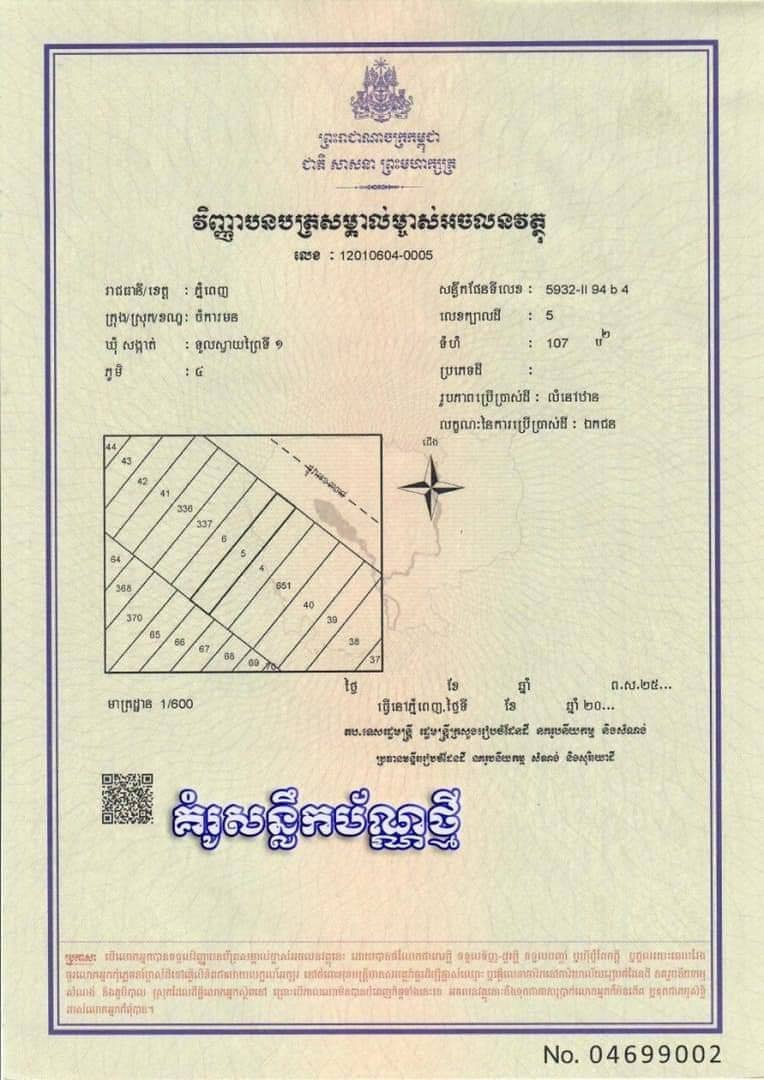
The single most important document in any Cambodian land transaction is the title. As of 2026, the vast majority of urban and peri-urban land transactions are hard title, and you should expect hard title in any purchase you make. This section covers what you need to know to navigate a land purchase; for the full breakdown of title types, registration history, and conversion mechanics, see our in-depth Cambodia title guide.
Hard title (ប្លង់រឹង). Issued by the national Ministry of Land Management, registered in the national land registry, and recognized everywhere in Cambodia. It can be sold, transferred, mortgaged, and willed without question — the only title that fully protects against overlapping claims.
LMAP title. A subset of hard title issued under the Land Management and Administration Project (World Bank-supported). LMAP areas are systematically surveyed and titled in blocks, so LMAP titles tend to be cleaner and more accurately surveyed than individually-applied hard titles. Same legal weight as hard title for practical purposes.
Soft title (rare in modern transactions). Issued at the commune or sangkat level, not in the national registry. As of 2026, no longer the practical option it used to be — most active land has been converted under systematic registration. Any seller offering soft title in a region where hard title is available is worth additional questions.
Master title (the situation to watch). When you buy a subdivided plot — for example, a 200m² residential plot carved out of a larger parcel by a developer — what you should receive is your own individual hard title. But until that individual title is issued, you may be holding only a sale agreement against the master title. Subdivision is legitimate and routine, but it requires the seller to follow through, and timelines vary. Your protection: a written sale agreement with a defined title-issuance deadline and clear refund triggers.
Where the developer or seller still holds title to the larger parcel and your individual title is "pending," the buyer's exposure persists even in 2026. Always confirm: is hard title issued in my name at handover, or is it pending subdivision? If pending, get the deadline in writing.
What land actually costs: 2026 price ranges by district.
Land prices in Cambodia vary dramatically by location, road access, plot shape, and zoning. The interactive map below shows current price ranges by commune, sourced from the Cambodian Valuers and Estate Agents Association (CVEA). Tap any district to zoom in, then tap individual communes for the full main-road and secondary-road price range.
These are reference ranges, not quotes. Actual prices depend on the specifics of any individual plot — road frontage, plot shape, neighbors, zoning. But the ranges give you a sober starting point for negotiation and a way to flag listings that look unusually high or low for their location.
Phnom Penh land prices by commune
Main road prices in USD per square meter. Tap a district to zoom in, then tap any commune for the full price range.
What land actually costs (the full stack).
The negotiated land price is the headline number, but several other costs apply.
1. The land price. As noted, 2026 is a buyer's market in most categories — expect meaningful negotiation room.
2. Stamp duty. 4% of the assessed property value (not the sale price), paid at title transfer. In most Cambodian land transactions, stamp duty is paid by the seller, not the buyer. This is conventional practice, though it can be negotiated either way in the SPA. Confirm explicitly in the contract who bears stamp duty before signing.
3. Land office (cadastral) and tax processing fees. Usually not included in the 4% stamp duty. Typically $1,000–2,000. Conventionally seller-side.
4. Title transfer & administrative fees. Notary, registration, document preparation. $300–800. Conventionally seller-side.
5. Title search fees. $1.25 per title (5,000 KHR) for ownership check via MLMUPC portal or bank app; $5 per title for mortgage/encumbrance status. Buyer-side.
6. Survey & boundary verification. Fresh cadastral survey to confirm boundaries and area. Typically $200–500. Buyer-side.
7. Legal & due diligence fees. Title-search and document review by a Cambodian property lawyer: $300–1,500. Strongly recommended for any purchase where the dollar amount is meaningful to your finances. For trust-structured foreign purchases, non-negotiable.
8. Financing (if applicable). Land mortgages are less common in Cambodia than house or condo mortgages — some banks won't finance raw land. Where available: larger down payments (30–50%), shorter terms (5–15 years), higher rates (8–11%).
The convention in most Cambodian land transactions is that the seller pays stamp duty (4%), land office processing ($1,000–2,000), and title transfer fees ($300–800). The buyer pays survey, legal fees, and title search costs. This is convention, not law — any of these can be renegotiated, but always specify in writing in the SPA.
The real-world transaction structure.
Land transactions in Cambodia follow a few standard payment patterns. Almost all transactions are denominated in US dollars. Bank transfer is preferred, though some transactions still involve cash — if cash is unavoidable, ensure every payment is documented with official receipts.
The standard cash purchase: deposit → 30% → 70%
- Reservation deposit ($1,000–5,000 or 5% of purchase price) to take the listing off the market and lock the price while you complete due diligence.
- 30% wire on SPA signing. Pay 30% of the purchase price via bank transfer at the time the Sale and Purchase Agreement is signed (and notarized). The seller initiates title transfer processing.
- 70% on hard title transfer completion. Pay the remaining 70% via bank transfer once the title has been transferred into your name at the cadastral office.
The variant: 50% / 50%
For smaller or more straightforward transactions, some sellers prefer a simpler 50/50 split — 50% at SPA signing, 50% at title transfer. Both structures are common.
The trust / escrow path: 10% / 90%
For foreign buyers using a trust structure, the typical split is much more conservative — 10% at SPA signing, 90% held in escrow (often with the licensed trustee or a bank escrow service) until the trust is registered and the title is held by the trustee on your behalf. The 90% releases only when all verification is complete. This mirrors how cross-border real estate transactions are handled in other jurisdictions and provides much stronger buyer protection than the standard cash payment pattern.
Cambodian land transactions are denominated in USD and almost always settle through bank transfer. Every payment should go to the seller's verified corporate or personal account in their legal name — never to a friend's account, an agent's account, or via cash without documentation. A clean payment trail is your strongest evidence if anything is later disputed.
The 30/70 (or 50/50) structure ties the seller's incentive to actually completing the title transfer. If you pay 100% upfront, the seller has no operational reason to push title processing through quickly. By holding back the majority of payment until you have the new title in your name, the timeline stays on track and disputes are dramatically reduced. Sellers who push for full upfront payment are deviating from standard Cambodian practice.
The 2019 Trust Law and your options.
Foreigners cannot own land directly in Cambodia. Article 44 of the Constitution and the 2001 Land Law reserve land ownership for Cambodian nationals and Cambodian-majority entities. What changed in 2019, and continues to mature, is the legal infrastructure for foreigners to hold beneficial ownership of land through a regulated trust structure.
Before the 2019 Trust Law, foreigners had three uncomfortable options: a Land Holding Company (51%-Cambodian-owned), a long-term lease (15–50 years), or a personal nominee arrangement (legally risky and increasingly discouraged). The Trust Law adds a fourth option, now widely regarded as the preferred path.
How a Cambodian property trust works
You (the settlor) appoint a licensed trustee to hold legal title to the land. You are the beneficiary, with full economic rights: rental income, resale proceeds, the right to sell or transfer, and the right to direct the trustee. The trust is registered with the Trust Regulator under the Ministry of Economy and Finance, and you receive a trust deed certificate as proof of your beneficial ownership.
The trustee has fiduciary obligations to act on your instructions and cannot transfer or encumber the property without your consent.
Licensed trustees in Cambodia
The Trust Regulator awarded the first inaugural licenses in 2023. Licensed trustees in Cambodia include Cana Trust (part of Canadia Group), Phillip Trustee (Cambodia) (an affiliate of Phillip Bank, part of Singapore's Phillip Capital Group), Stronghold Trustee, Hao Trust Capital Investment, SG Top, and Grand Cathay Investment Trust, among others.
The Trust Regulator's portal (trustregulator.gov.kh) maintains the current list of licensed trustees — always verify a trustee's current license status before engaging them. Fees, services, and structures vary by trustee, so request quotes from at least two licensed trustees before deciding.
What the trust process actually looks like
Setting up a property trust in Cambodia follows a defined workflow that typically takes 3–5 months from initial consultation to title transfer completion. The general structure, drawing on the public process flow published by Phillip Trustee:
Trusteeship consultation
InitialInitial advisory engagement, fee quotation, service agreement.
Pre-trusteeship due diligence
~5 working daysProperty and legal due diligence carried out by a third party. The land verification report determines whether to proceed.
Sales & Purchase Agreement
~3–5 working daysDiscussion of land price and payment phases with the seller, consultation with a lawyer, SPA creation. The trustee signs the SPA on the trustor's behalf.
Trust agreement entered
~5 working daysTrust deed signed between trustor and trustee. The trustor wires the trust fund to the trustee's bank account.
Property purchase
~1 monthThe land title is transferred under the trustee company's name on the date stated in the agreement.
Ownership transfer
~2–3 monthsApplication, transfer/registration of titles with the Cadastral Office, stamp duty payment, completion of the registration process. Trust ownership confirmed with the trustor.
Trust registration with Regulator
Within 3 monthsMust be completed within 3 months after the trust establishment date for the trust to be valid.
The four pathways for foreigners, compared
| Trust (2019) | Land Holding Co. | Long-term lease | Personal nominee | |
|---|---|---|---|---|
| Legal certainty | High | High | High | Low |
| Complexity | Moderate | High | Low | Low (but risky) |
| Resale path | Transfer beneficial interest | Sell shares or assets | Assign lease | Difficult |
| Asset protection | Strong | Strong (governance risk) | Moderate | Weak |
| Ongoing obligations | Trustee + regulator | Company filings, accounting | None after setup | None |
| Best for | Individual investors, long-term hold | Multi-property, business | Defined-period use | Avoid |
A trust does not turn a foreigner into a Cambodian landowner. The Constitution still reserves direct land ownership for Cambodian nationals. The trust gives you legally protected beneficial ownership — economic control of the property — but the legal title sits with the trustee. Marketing copy that frames a trust as "100% direct ownership" or "iron-clad foreign land ownership" is oversimplifying.
The honest comparison: trust vs. lease
For foreign buyers who don't need land ownership specifically (you want to develop or occupy a property for a defined period), a long-term lease is simpler, cheaper, and well-understood. A 50-year lease, properly registered with the cadastral office, gives you strong tenure and full development rights. A trust makes more sense when you want to hold land as a long-term asset with the ability to transfer beneficial ownership to a future buyer or heir.
For most foreign property investors in 2026, the trust is the right structure. For most foreign businesses occupying premises, a registered long-term lease is the right structure.
The eight steps from "land for sale" to title in your name.
The end-to-end process for a typical Cambodian land purchase. Length varies — 4–8 weeks for a straightforward urban transaction, 3–6 months for more complex purchases.
Define what you're buying for
Owner-occupation, subdivision, hold-and-resell, commercial development, or trust-held investment (foreign buyer). The use case determines what to look for and what to verify.
Identify candidate plots
Through agencies, PropertyHub listings, or direct sign-listings. For first-time buyers, working through a reputable agency is the lowest-risk path — they pre-screen title issues before you ever see the plot.
Walk the land
Visit in person, walk every boundary. Look for existing structures, fences in unexpected positions, water flow during rainy season, neighbors using parts of the parcel, paths or roads crossing the land that aren't on the survey.
Request the title and seller's ID
Photograph both. Note the title number, the registered owner's name, the area, and the boundary description. Compare the registered area to your eyes-on estimate of the plot.
Run a title search
Through the MLMUPC online portal or your bank's app — both offer this service. The cost is 5,000 KHR (~$1.25) per title for ownership verification, and $5 per title for mortgage/encumbrance status. Confirm: the seller is the registered owner, there are no liens or registered mortgages, no overlapping titles, and the boundaries on file match what you walked.
Sign a sale agreement (with deposit)
A written sale agreement with a deposit ($1,000–5,000 or 5% of purchase price) locks the deal while you complete final diligence. The sale agreement specifies the agreed price, the property description (with title number), the payment schedule, the title transfer timeline, the allocation of stamp duty and processing fees, and clear refund conditions.
Notarized SPA & first payment
The Sale and Purchase Agreement is notarized at signing. Pay 30% (or 50%, depending on the structure) via bank transfer in USD. The seller initiates title transfer processing at the land office.
Title transfer & final payment
The seller handles stamp duty payment and registration. Once the title transfers into your name and the new title document is issued by the cadastral office, you pay the remaining balance via bank transfer. You receive the title document; the seller receives the final payment in the same transaction window.
Title due diligence in practice.
Systematic land registration has made title diligence simpler than it used to be, but the buyer's responsibility hasn't disappeared. Here's what a thorough check actually involves in 2026.
1. Run the title search yourself. Through the MLMUPC web portal or your bank's app — $1.25 for ownership verification, $5 for mortgage status. Do this before any serious deposit. The results tell you: registered owner, title issuance date, registered area, registered encumbrances.
2. Boundary match. Walk the parcel with the title document in hand. Boundaries described in the title must match what you walk. Any discrepancy is a serious flag — commission a fresh cadastral survey if there's doubt.
3. Document chain. Trace the title back through previous owners via a property lawyer. How long has the current seller held the title? Sudden short-term ownership before resale (less than 6–12 months) is worth investigating.
4. Co-ownership and family claims. Spouses, siblings, and adult children can later contest sales. More common in ancestral or provincial land than urban. Verify written consent from all relevant family members.
5. Encroachment. Are neighboring structures or fences extending into the parcel you're buying? Has any portion been informally occupied? Resolving encroachment after purchase is significantly harder than walking away from it before.
6. Access and easement. Does the parcel have legally guaranteed road access, or does access depend on a neighbor's goodwill? Land without recorded road access is a real and recurring problem.
7. Zoning and use (for commercial). Verify the zoning category at the commune office and confirm your intended use is permitted. Especially important for commercial land where construction permits later depend on zoning.
For any land purchase, retain a Cambodian property lawyer for title diligence unless the dollar amount is insignificant to your finances. A few hundred dollars in legal fees can prevent a multi-year ownership dispute, and the relative cost of legal review is small against any meaningful transaction. For trust-structured purchases by foreign buyers, a lawyer is non-negotiable — you'll need one to set up the trust structure correctly anyway.
Notable land agencies.
Most first-time land buyers in Cambodia work through agencies. The good ones add real value: they pre-screen title issues, know the local market, manage paperwork through the land office, and act as a buffer between buyer and seller. The bad ones do none of these things and can introduce their own risks (commissions paid by both sides, incentive to close deals on questionable plots, unverified listings).
PropertyHub maintains an editorial framework for evaluating land agencies. The agencies below have been included based on the criteria stated underneath.
Established Cambodian agency working across both local and international buyer segments, with experience handling residential and commercial transactions across Phnom Penh and the major provinces.
Recognized for cross-border buyer support and a strong listings inventory across residential and commercial categories. Active across Phnom Penh and provincial markets.
Well-established agency serving both domestic and international clients across the full property spectrum. Strong presence in central Phnom Penh.
International buyer focus, with significant experience advising foreign investors on Cambodian property structures including condominiums, land via trust, and commercial properties.
Cambodian-focused agency with deep knowledge of the local market and seller networks. Well-suited to buyers seeking domestic representation across residential and commercial land.
Domestic agency known for working closely with Cambodian buyers across the residential and commercial spectrum, with strong relationships in the seller community.
Editorial inclusion criteria
- Active RPR license (Real Estate Business and Pawnshop Regulator, under the Ministry of Economy and Finance)
- CVEA membership (Cambodian Valuers and Estate Agents Association)
- Documented title-verification process before listing
- At least 5 years of operation, or international affiliation backing
- No active customer disputes or regulatory action known to PropertyHub at time of publication
- Transparent fee disclosure
This list is editorial — none of the agencies above are paid placements. Inclusion reflects market presence and meeting the criteria above, not endorsement of any specific transaction. License numbers shown are current RPR codes issued by the Real Estate Business and Pawnshop Regulator under the Ministry of Economy and Finance; verify any agency's current license status directly with RPR before signing. Always do your own due diligence using our checklist.
The land buyer's due diligence checklist.
We've turned this entire guide — plus the title diligence section — into a 7-page printable checklist designed for the land office and the site walk-through:
Checklist
The complete land buyer's checklist
Get the printable PDF with all the questions, red flags, and checkboxes from this guide — formatted for your land office visit and boundary walk-through.
- →14 questions to ask the seller before signing
- →20 items to check at the land office (with MLMUPC portal step-by-step)
- →A boundary walk-through checklist
- →A title-risk scoring sheet
- →For foreign buyers: a trust-structure decision tree
We'll send the PDF to your Telegram. We'll only follow up with property recommendations if you said you're buying within 6 months.
Red flags specific to land purchases.
Most land purchases go through fine. The ones that don't fail in patterns. Land has more failure modes than boreys or condos because the buyer is in direct contact with title risk.
The seller can't or won't produce the title for you to photograph.
Walk away from any seller who will only 'show' the title and not let you examine it carefully. There's no legitimate reason to refuse.
Soft title in an area where hard title is standard.
In 2026, this is unusual and worth asking about. May indicate an unresolved claim or an unconverted parcel that hasn't gone through systematic registration.
Recent ownership changes.
The seller acquired the title within the last 6–12 months and is now reselling. Not automatically wrong, but worth investigating — sometimes indicates flipping of unclean titles before issues surface.
Boundaries on the title don't match the boundaries on the ground.
Walk the parcel with the title document in hand and compare. Any discrepancy is a serious flag.
Neighbors using parts of the parcel.
Fences, paths, structures, or active occupation by people other than the seller. Encroachment becomes your problem the moment you buy.
The seller is one of multiple potential heirs and the others haven't consented.
Ancestral land disputes can surface years after a clean-looking sale. Get written consent from all relevant family members, or walk away.
No clear road access.
The parcel depends on crossing a neighbor's land, an unregistered path, or an informal arrangement. Verify access is on the title or in a registered easement.
The SPA is not notarized.
An SPA without proper notarization is significantly harder to enforce in Cambodian courts. Walk out. Non-negotiable, regardless of the seller's reputation.
The seller pressures you to pay outside formal channels.
Cash to a personal account, payments without receipts, 'informal' handshake parts of the deal. Every payment should leave a paper trail.
The seller wants 100% upfront.
Departure from the standard 30/70 or 50/50 Cambodian transaction pattern. Push back hard — paying everything before title transfer removes your only leverage if the seller doesn't follow through.
Master title still held by a developer with no clear subdivision timeline.
If you're buying a subdivided plot and the developer still holds the master title, get the subdivision and title-issuance timeline in writing with refund triggers.
For foreign buyers: a 'trust' arrangement set up outside the licensed framework.
Some operators offer informal 'trust-style' arrangements that aren't registered with the Trust Regulator. These are not protected by the 2019 Trust Law. Verify your trustee is licensed at trustregulator.gov.kh.
Frequently asked questions
Ready to start your search?
You've got the framework. The next step is to see what's actually on the market in your target area and price range.
Browse land on PropertyHub →Checklist
Take the checklist with you.
Seven pages, designed to print or read on mobile during a site visit.
Send me the checklist on Telegram