What is a borey, exactly?
A borey (បុរី) is a gated residential development in Cambodia, typically built and sold by a single developer, where each home sits on its own land plot inside a planned community with shared roads, security, and amenities. The word is borrowed from Sanskrit and historically meant "city" or "town" — and that's roughly the right mental model. A small, self-contained neighborhood rather than a single building.
What makes boreys distinct from anywhere else you'd buy a house in Cambodia is the package deal: the land, the building, the road, the gate, the security, and the title processing all come from the same developer. For first-time buyers, that's a big deal. You're not negotiating separately with a landowner, a contractor, and a notary — you sign one set of documents and get keys to a finished home.
Boreys come in every price tier. A two-storey link house in an outer-ring borey might cost $45,000–$70,000. A villa in a premium borey near central Phnom Penh can run past $500,000. The format is the same; the finishes, location, and amenities are what change.
Boreys make up the majority of new housing supply around Phnom Penh.
Most new residential units delivered in Greater Phnom Penh in recent years have been borey homes — link houses, twin villas, queen villas, and king villas built inside planned developments.
Why most first-time Cambodian buyers start with a borey.
If you're buying your first home in Cambodia, the path of least resistance is almost always a borey. Five reasons it tends to win out over the alternatives:
1. Predictable pricing. Developers publish unit prices openly, often with a sales chart at the showroom. You're not haggling over land per square meter and then again over construction costs — the price is the price.
2. Financing is built in. Most boreys have one or more bank partners with pre-approved project financing. Walk in, get pre-qualified the same day. Buying off-borey means arranging a mortgage from scratch.
3. Hard title is standard. Reputable boreys deliver hard title (ប្លង់រឹង) to every buyer. Buying older properties off-market, you might find yourself negotiating around soft title or unclear ownership.
4. Security and infrastructure are handled. Roads, drainage, lighting, gates, and 24-hour security are baked into the development.
5. Resale liquidity. Boreys in established locations have an active resale market.
Boreys are convenient but tend to look alike.
If architectural distinctiveness matters more to you than convenience, a custom-built house on private land may be the better path — at the cost of more time, more risk, and more paperwork.
The four borey unit types you'll encounter.
Boreys sell standardized house types with names that have become industry shorthand. The same labels appear across most developers, so it's worth knowing them before you visit a showroom.
Link house (ផ្ទះល្វែង).
The most common and most affordable. Houses share walls with neighbors on both sides — typically two storeys, narrow frontage (4–5m), deep plot. Entry-level format and what most first-time buyers buy.
Twin villa (ភ្លោះ).
Two houses sharing one wall. More frontage and natural light than a link house, modestly more expensive.
Queen villa
A standalone house on a small plot — no shared walls. Usually two-and-a-half storeys, with a small front yard. The mid-tier choice.
King villa
Standalone house on a larger plot, with a front yard, side garden, and parking for two cars. The premium tier within most boreys.
| Type | Plot Size | Floors | Shared walls | Parking | Price Range | Best for |
|---|---|---|---|---|---|---|
| Link house | 4×16m | 2 | Both sides | Street/front | $45–200k | Singles, young couples |
| Twin villa | 7.5×20m | 2 | One side | 1-2 car | $100–300k | Small families |
| Queen villa | 10×25m | 2.5 | None | 2 cars | $200–900k | Families wanting privacy |
| King villa | 12×25m+ | 2.5–3 | None | 2+ cars | $500k+ | Established families |
The pricing gap between tiers within the same borey is usually 30–60%. The same tier across different boreys can vary by 5–10× depending on location and brand. Browse link houses or browse king villas on PropertyHub.
Notable boreys you should know
Cambodia's borey market is dominated by a small number of large developers who have built reputations over a decade or more. These are the brand names you'll hear referenced at showrooms and in conversations. Knowing who's who helps you read the market — and gives you reference points when comparing a smaller, less established developer.
This list is editorial — none of the developers above are paid placements. Inclusion reflects market presence and recognition, not endorsement of any specific project. Always do your own due diligence using our checklist.
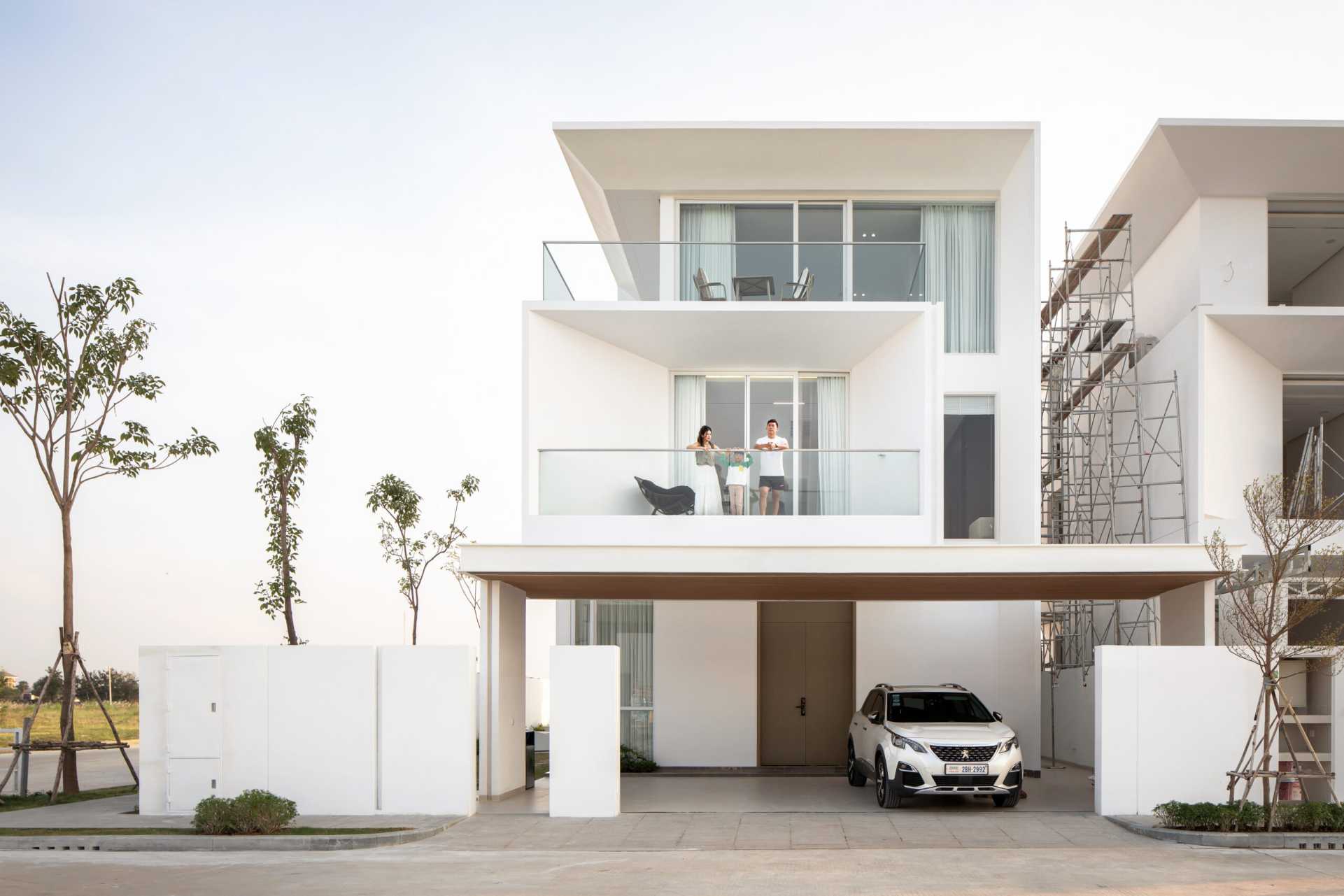 Featured
A boutique-scale development in south Phnom Penh built around a single architectural idea: an open back-garden courtyard that connects the kitchen, dining, and living areas into one continuous space — with a private pool at its center. The 5-minute drive to AEON Mall 3 and 15-minute access to Techo International Airport make daily logistics simple. Suited to families who want the privacy and standalone feel of a single villa without the price of a king villa.
View the project →About sponsored listings. Featured partner placements are paid promotional positions. PropertyHub reviews each featured listing for basic accuracy (developer registration, title type, headline pricing) but does not endorse specific projects. Sponsored placements do not affect editorial picks above.
Hard title is non-negotiable. Here's why.
The single most important document in any Cambodian property transaction is the title. There are several kinds, and the differences range from "minor inconvenience" to "you don't actually own this." For a first-time buyer, the rule is simple: get hard title, or walk away.
Hard title (ប្លង់រឹង)
Issued by the national Ministry of Land Management, recognized everywhere, transferable, mortgage-able, and protected by the national land registry. The only document that gives you full, unambiguous ownership.
Soft title
Issued at the commune or district level. Recognized locally but not in the national registry. Cheaper and faster, but harder to mortgage, harder to resell at full value, and vulnerable to disputes.
LMAP title
A subset of hard title issued under a specific systematic land registration program. Functionally equivalent to hard title for ownership purposes.
Strata title
Used for condominiums and high-rise units. Not relevant for borey houses (which are landed property), but worth knowing if you're comparing borey-vs-condo.
The good news: most reputable boreys deliver hard title at handover or shortly after. The bad news: some developers — especially smaller or newer ones — sell on a "title pending" basis. This isn't automatically a red flag, but it requires extra diligence: see the master title, check the developer's track record, and get a written commitment with a deadline.
Insist on this clause in your contract.
"Hard title (ប្លង់រឹង) to be issued in buyer's name within [X] months of handover, failing which buyer is entitled to a full refund plus [Y]% interest." If the developer won't sign that, the title is not as secure as the salesperson is telling you.
| Hard title | Soft title | LMAP | Strata | |
|---|---|---|---|---|
| Issuing authority | National (Ministry) | Commune/district | National (program) | National (condos) |
| In national registry | Yes | No | Yes | Yes |
| Mortgage-able | Yes | Difficult | Yes | Yes |
| Resale liquidity | High | Lower | High | High |
| Use case | All borey purchases | Older off-market homes | Same as hard | Condos only |
What a borey actually costs (the full stack)
The sticker price on the showroom chart is not the price you'll actually pay. There are five additional cost categories that first-time buyers consistently underestimate. Here's the full stack.
- The unit price. The published price for the house.
- Stamp duty. Currently 4% of assessed property value, paid to the government.
- Title transfer fees. Notary, registration, and government charges. Budget $300–800.
- Bank fees if financing. Loan processing, valuation, insurance.
- Move-in & finishing. Many boreys deliver rough finish. Budget $5,000–15,000.
- Ongoing maintenance. $10–50/month for entry-level, $50–150/month for premium.
Budget 8–12% on top of the sticker price
Total transaction costs (stamp duty, bank fees, title transfer, first-year maintenance) come to roughly 8–12% of unit price.
The six ways Cambodians pay for a borey
“How will you pay?” is the first practical question a sales agent will ask after you express interest in a unit. The answer determines everything that comes next — which contracts you sign, in what order, and how much total you end up paying. Most first-time buyers assume the choice is “cash or mortgage.” It's actually a spectrum of six paths, and developers offer different combinations depending on the project and the season.
Here are the six payment paths you'll encounter, from fastest to most flexible.
Pay-off in full (upfront)
A single lump-sum payment, usually at SPA signing or within 30 days. The price is the price, but the discount is real.
Reserve → sign SPA → pay 100% within 30-90 days → handover and title transfer. Developers typically offer a 5–15% discount versus the chart price for cash payment, because they avoid carrying receivables and waiting for installment risk.
Best for: Buyers, business owners with liquid capital, or anyone with savings ready to deploy. The simplest path — no bank, no installment risk, fastest to title.
Fast installment (developer)
Short-term installment plan directly with the developer, typically 6–24 months. Smaller discount than cash but no bank involved.
Reserve → sign SPA → pay 30–50% down → balance in monthly installments over 6–24 months, interest-free or low interest. Title transfers when the final payment clears. No bank, no loan application, no mortgage on the property.
Best for: Buyers with strong cash flow but not enough liquid savings for upfront. Common for off-plan purchases where the installment schedule aligns with construction milestones.
Relaxed installment (developer)
Longer-term installment plan, often 3–10 years, offered directly by the developer. Effectively a developer-extended payment plan rather than a traditional mortgage.
Reserve → sign SPA → pay 10–30% down → balance in monthly installments over 3–10 years. The developer holds the title until full payment. Interest rates may apply and can be higher than bank mortgages on paper, but eligibility is far broader — no formal income verification, no bank approval.
Best for: Buyers who can't qualify for a bank mortgage (informal income, no payslips, self-employed without proper documentation). The most accessible path, but watch the total cost over the full term.
SPA + bank mortgage
The classic path. Sign the SPA, then apply for a mortgage at a commercial bank. The bank pays the developer; you pay the bank over 10–25 years.
Reserve → sign SPA (often contingent on financing) → apply at a bank with 3 months of statements, ID, and proof of income → bank approval (1–4 weeks) → bank disburses to developer → you pay bank monthly. Note: SPA signing and loan approval are two separate stages, and one does not guarantee the other.
Best for: Salaried first-time buyers with formal income documentation. The most institutionalized path, with the most consumer protection — your name goes on the title from the start.
Hybrid (down + mortgage)
A common real-world path: pay a meaningful down payment in installments to the developer, then take a smaller bank mortgage for the remaining balance at handover.
Reserve → sign SPA → pay 30–50% to the developer in installments during construction → at handover, apply for a bank mortgage covering the remaining 50–70% → bank disburses to developer at completion → you pay the bank. Reduces the loan size (and therefore monthly burden) while preserving cash flow during construction.
Best for: Buyers with moderate savings buying off-plan. The most pragmatic path for many first-time buyers — combines the discipline of saving during construction with the leverage of a smaller bank loan at the end.
Developer loan
Some developers extend an in-house "loan" structure that looks like a bank mortgage but is held entirely by the developer. Title is retained until repayment.
Reserve → sign SPA + developer loan agreement → pay 10–20% down → balance in monthly installments over 5–15 years at developer-set interest rates (often higher than banks). Developer holds title throughout. Sometimes marketed as "easy financing" for buyers who can't access bank credit.
Best for: Buyers with no other option. Verify the developer's track record carefully — you're trusting them with both your money and your title for years. Read the contract clause-by-clause; default penalties can be severe.
SPA signing and loan approval are not the same event.
Many first-time buyers assume “the bank approved my loan” means the purchase is locked in, or that “I signed the SPA” means the financing is guaranteed. They're separate stages, and either can fall through independently. Always confirm: (1) what happens to my deposit if the loan is denied after SPA signing, and (2) what happens if I want to walk away after loan approval but before disbursement. Get both in writing.
If you go the bank mortgage route (Paths 04 & 05)
Down payment. Typically 20–30%. Some banks go to 10% for salaried customers; others require 40% for self-employed buyers.
Loan term. Most banks offer 10–25 year terms.
Interest rate. Cambodian mortgage rates are typically 7–10% per year. Most rates are floating and reset annually.
Currency. Most mortgages are denominated in US dollars.
Pre-approval. Walk in with three months of bank statements, your ID, and proof of income. The developer's partner bank can often pre-qualify you the same day.
The developer's bank isn't always your best option.
Get a quote from at least one independent bank. A 0.5% lower rate on a $80,000 mortgage saves $400/year — over a 20-year loan, that's $8,000.
The eight steps from showroom to keys
The end-to-end process from “I'm interested” to “I have keys and a hard title in my name” usually takes 2–6 months for a ready unit, longer for off-plan. Here's what happens at each step and what to ask.
Shortlist and visit
Identify 3–5 boreys that match your budget and location. Visit each in person at different times of day (morning traffic, evening security). Photograph the entrance, road condition, surrounding area, and any unit you're seriously considering.
What's traffic like at 7am and 6pm? Has the road flooded in the past two rainy seasons? How many units are sold vs. unsold?
Verify the developer
Look up the developer's past projects. Visit one that's been completed for 2+ years. Talk to actual residents. Search the developer on social media and Cambodian property forums.
What's the developer's track record on title delivery timelines? Have past projects had any disputes? See our guide to developer due diligence.
Confirm the title situation
Get clarity on the master title and your individual title. If the development is delivering on a "title pending" basis, get the projected date in writing.
Is hard title issued at handover or after? If after, how long? What's written into the contract if it's late?
Reserve the unit
Sign a reservation agreement and pay a deposit ($500–2,000). This locks the unit and price for 14–30 days while you complete financing arrangements.
Is the reservation deposit refundable if my loan is denied? Get this in writing.
SPA signing
Sign the Sales & Purchase Agreement (កិច្ចសន្យាទិញលក់). Read it carefully — payment schedule, handover date, default penalties, title delivery timeline. If anything is verbal, get it added. The SPA must be notarized to be enforceable in Cambodian courts; insist on notarization at signing, not "later."
SPA signing happens before loan disbursement and is a separate event from loan approval (Step 6). If you're paying via Path 04 (SPA + mortgage), the SPA should include a financing-contingency clause: if your loan is denied within a defined window, you can exit with your deposit returned.
Is the SPA notarized at signing? What's the late-handover penalty vs. the late-payment penalty — are they symmetrical? What happens if my loan is denied after I sign? More on the Cambodian SPA.
Loan approval & disbursement
If you're going the bank mortgage route (Paths 04 & 05), this is where the bank processes the formal loan application: property valuation, income verification, credit check, and underwriting. Approval typically takes 1–4 weeks. Once approved, the bank disburses directly to the developer in tranches matching your SPA payment schedule.
If you're on a cash, fast installment, relaxed installment, or developer loan path, this step looks different — you're executing the payment schedule directly with the developer, not waiting for a bank.
How long does final approval typically take from your bank? What's the disbursement schedule? What documents do you need from me to release the next tranche?
Payment & handover
Pay according to schedule. At handover, do a thorough walk-through with a checklist (see Section 8). Note every defect in writing.
What's the post-handover defect liability period? Most reputable developers offer 6–12 months of warranty.
Title transfer
The developer processes the title transfer to your name. Pay stamp duty and registration fees. Once your name is on the title, the purchase is legally complete.
Will the developer pay for and/or assist with stamp duty processing, or is that on me?
The due diligence checklist (free PDF)
We've turned this entire guide into a 6-page printable checklist that you can take to the showroom and the handover walk-through. It covers:
The complete borey buyer checklist
Get the printable PDF with all the questions, red flags, and checkboxes from this guide — formatted for your showroom visit and handover walk-through.
- →14 questions to ask the developer before you reserve
- →23 items to inspect during the handover walk-through
- →8 documents to collect at title transfer
- →A budget worksheet for the full cost stack
- →A red-flag scoring sheet to compare boreys side-by-side
We'll send the PDF to your Telegram. We'll only follow up with property recommendations if you said you're buying within 6 months.
Red flags and the five mistakes first-time buyers make most often
Most borey purchases go fine. The ones that don't, fail in predictable ways. Here's the pattern.
The developer can't show you a finished, occupied past project.
Every developer started somewhere, but for a first-time buyer, no track record is meaningfully bigger risk. Either pay a premium for a proven brand, or accept the risk consciously and price it in.
The price is significantly below comparable boreys nearby.
A 10% discount is normal competition; a 30% discount usually means something — bad location, title issues, structural shortcuts, or financial stress at the developer.
Hard payment schedule, soft handover date.
"Buyer pays on schedule X; developer hands over approximately Y" is asymmetric. Reputable developers commit to handover dates with penalties for slippage.
The SPA is not notarized.
An SPA without proper notarization is significantly harder to enforce in Cambodian courts. Any legitimate developer will arrange notarization at signing, often with a notary present at the office. If you're told "we'll notarize it later," "the lawyer will sign separately," or "notarization isn't necessary for this kind of contract," walk out. This is non-negotiable, regardless of the developer's reputation.
The salesperson pressures you to sign today.
"This price is only good if you reserve today" is a sales tactic, not a market reality. A 48-hour hold while you review the contract is reasonable to ask for.
The road in front isn't paved or hasn't been formally accepted by the commune.
A Cambodia-specific issue. Some developments depend on roads that the developer paid for but the commune hasn't taken over. Maintenance can become a problem in year 5.
The borey is being marketed primarily to overseas buyers as an "investment."
Investor-heavy boreys often have low owner-occupancy, which weakens the resale market and the community feel.
You're being asked to pay in cash with no receipt.
All payments should go to the developer's corporate account against an official receipt. Never to a personal account.
The five most common first-time-buyer mistakes
- Skipping the second visit. Boreys look different at 6pm than at 11am. They look very different in heavy rain.
- Not reading the maintenance fee schedule. Some boreys have fees that escalate after the first 2 years.
- Underestimating finishing costs. “Rough finish” can mean $10k+ before you can move in.
- Trusting verbal commitments. Anything that's not in the SPA, isn't real.
- Not budgeting for stamp duty and title transfer. These are paid in cash at title transfer time, not financed by the bank.
Borey vs. land vs. condo vs. older flat: which is right for you?
Boreys are the default for first-time buyers, but they're not the only option. Here's how they compare.
| Borey | Land + build | Condo | Older flat | |
|---|---|---|---|---|
| Title | Hard (standard) | Hard (verify) | Strata | Hard or soft |
| Time to move in | 0–6 months | 12–18 months | 0–6 months | 0–1 month |
| Mortgage availability | Strong | Possible (harder) | Strong | Limited |
| Customization | Low | Highest | Low | Moderate |
| Resale liquidity | High | Moderate | High | Lower |
| Best for | First-time buyers | Custom design | Foreign buyers | Diligence-comfortable |
The honest summary: if you're buying for the first time, your timeline is 12 months or less, and you don't have strong opinions about architecture, a borey is almost always the right answer. Otherwise, look at buying landor a condo.
Where to look: borey hotspots around Phnom Penh
Borey supply concentrates in specific districts around Phnom Penh, each with a different price point and buyer profile.
Good road access to central PP via Monivong Bridge. Heavy supply, growing fast.
Established borey corridor along Russian Federation Blvd. Mature infrastructure.
Newer supply, large developments. Strong choice for value-conscious buyers.
Closer to central PP. Mix of older and newer boreys.
Furthest out, lowest prices. Best for buyers prioritizing budget over commute.
Mix of older and newer boreys with good amenity access.
Frequently asked questions
Ready to start your search?
You've got the framework. The next step is to see what's actually on the market in your target area and price range.