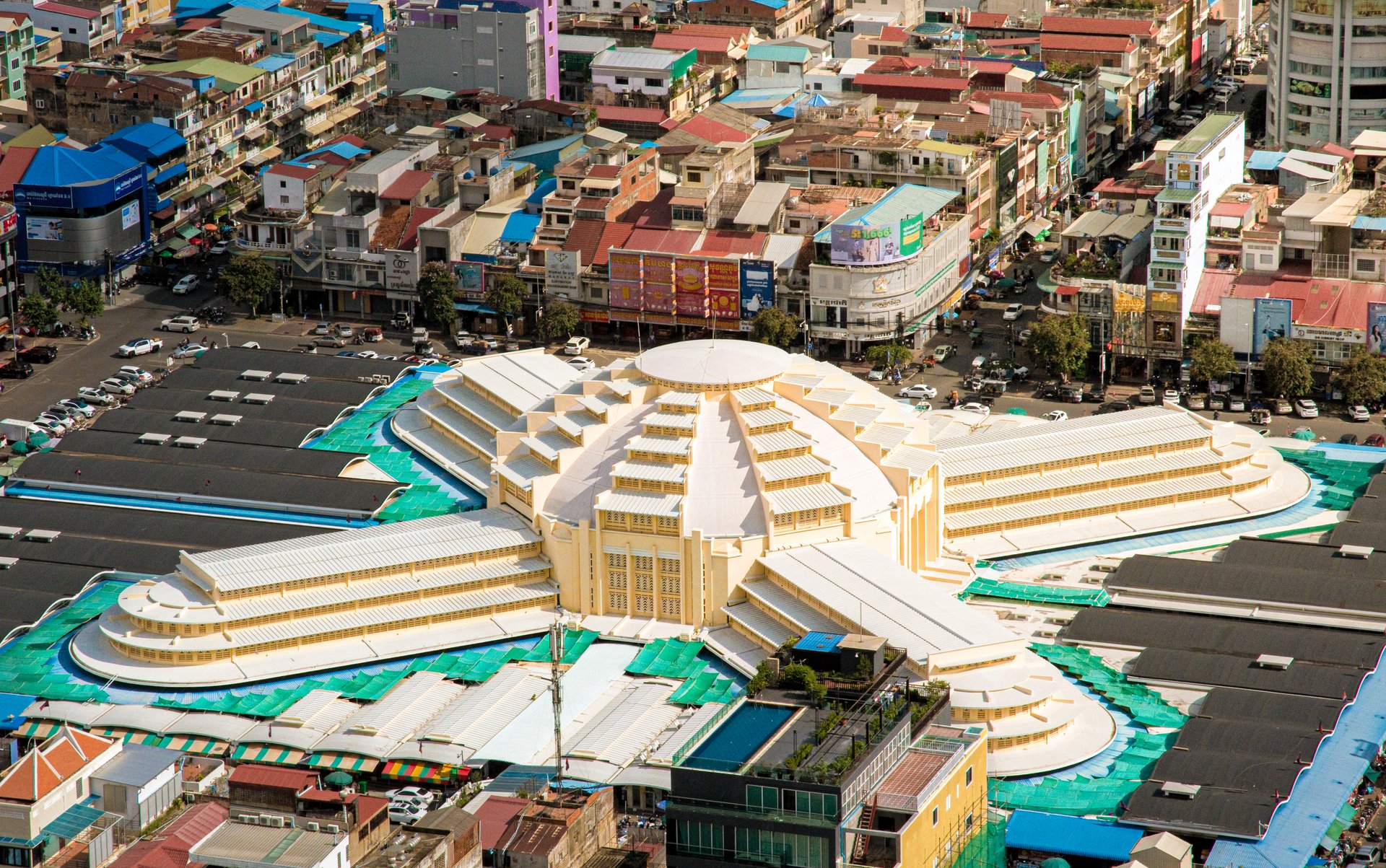
Phsar Thmei — the Central Market
The Art Deco icon that anchors Daun Penh. Built in 1937, it was Asia's largest market when it opened — and it still defines the neighbourhood.
The Central Market (Khmer: ផ្សារធំថ្មី, Phsar Thum Thmei — "New Grand Market") is Phnom Penh's most recognisable architectural landmark outside the Royal Palace. Completed in September 1937 and inaugurated by King Sisowath Monivong, it was designed by French city architect Jean Desbois and built under the supervision of Louis Chauchon. When it opened, it was said to be the largest market in Asia.
The building is a masterpiece of Art Deco design — the largest example of the style in all of Asia. Its distinctive pale yellow central dome rises 26 metres, with four radiating wings branching out to create vast hallways housing over 3,000 stalls. The four-wing cruciform plan is said to represent a lotus flower — a symbol of purity in Cambodian Buddhism. The design is also a feat of engineering: the fully enclosed building stays naturally ventilated through its dome, keeping vendors and shoppers comfortable in Cambodia's tropical climate.
The market was built on drained marshland — the site was a lake until 1935. After bomb damage during the Franco-Thai War (1940–1941), the market was fully renovated between 2009–2011 at a cost of $4.2 million funded by the French Development Agency (AFD), preserving its emblematic architecture while modernising facilities.
What you will find inside: The central dome houses jewellery and gold — glass counters displaying silver bracelets, gold rings, and Khmer silverwork. The four radiating wings contain silk textiles, clothing, electronics, household goods, antique coins, Buddhist artefacts, wooden carvings, and souvenirs. The outer perimeter lane has fresh produce stalls serving primarily local customers. There is a food court on the western side with classic Cambodian dishes.
Wat Phnom — the hill that named the city
The hilltop temple that gave Phnom Penh its name. Founded in legend in 1373 by Lady Penh, rebuilt multiple times, and still the spiritual anchor of the Daun Penh district.
Wat Phnom (Khmer: វត្តភ្នំ, "Mountain Pagoda") is a Buddhist temple perched atop the city's only hill — a 27-metre manmade knoll at the northern end of central Phnom Penh. The site is the physical and mythological origin of the city, and its name is inseparable from the city's identity. "Phnom Penh" literally means "Penh's Hill" — named after the legendary woman who built the first shrine here.
According to tradition, in 1373, a wealthy widow named Lady Penh (Daun Penh, which also means "Grandmother Penh") discovered a floating Koki tree in the Mekong River. Inside its hollow trunk she found four bronze and brass Buddha statues and one marble Vishnu statue. Taking this as a divine sign, she directed villagers to build an artificial hill and a small wooden temple on top to house the statues. The surrounding settlement grew into what became Phnom Penh. In the 15th century, King Ponhea Yat moved the Cambodian capital from Angkor to this confluence of rivers, cementing Wat Phnom's status as the nation's spiritual and historical anchor.
The temple has been rebuilt four times — in 1434, 1806, 1894, and most recently 1926. The current temple features a central vihara with a large bronze seated Buddha on the main altar, murals depicting Jataka tales and scenes from the Reamker, and Naga balustrades flanking the grand eastern staircase. The stupa to the west is believed to contain the ashes of King Ponhea Yat. A small shrine in the southwest corner is dedicated to Lady Penh herself — perpetually crowded with devotees.
Today: Wat Phnom is both a major tourist attraction and an active place of worship. Locals come to pray for success in exams, business ventures, and personal decisions. It is a major pilgrimage site during Khmer New Year and Phum Ben (the festival of the dead). The hilltop park surrounding the temple is a popular spot for morning walks and evening strolls.
Apartments & condos in Daun Penh right now
Live listings for rent and for sale in Daun Penh — from shopfront apartments near the Central Market to premium serviced residences and CBD-adjacent condos. Full pricing visible, no form wall.
No listings found right now. Check back soon.
Daun Penh property & rent prices (2026)
Rental and sale prices across Daun Penh. The district spans a wide range — from basic shopfront apartments near the market to Cambodia's most prestigious Grade A serviced residences and CBD condos.
Rent & sale prices by type
Median asking prices, Daun Penh district
Wide range reflecting the district's mix — from affordable local apartments near the market to CBD-grade serviced residences. Grade A penthouses reach $7,500+. Office space: $10–$30/sqm.
See what these prices look like in real listings
Browse current apartments and condos in Daun Penh. Full pricing visible, no signup, no form wall.
Living in Daun Penh: who picks this area
A qualitative read of who actually lives in Daun Penh. Not a census, but useful for figuring out whether the district suits your lifestyle.
CBD professionals & corporate expats
Daun Penh hosts Cambodia's most prestigious office buildings — Vattanac Capital, Canadia Tower, Exchange Square, Raintree. The proximity to work makes it the top choice for senior corporate professionals, bankers, and diplomats who want a short commute and prefer CBD living. Oakwood Premier, Fairfield by Marriott, and serviced residences cater directly to this demographic.
The CBD walk-to-work crowdHistory & culture lovers
Daun Penh is Phnom Penh's historic core. Expats and long-term residents who love colonial architecture, authentic Cambodian street life, proximity to the Central Market, National Museum, Wat Phnom, and the Royal Railway Station choose this area for its cultural richness and genuine urban character that newer districts cannot replicate.
Authenticity seekersNightlife & social scene residents
Street 51 (Bar Street) and the Sisowath Quay promenade are among the best nightlife strips in Phnom Penh. Residents who want sunset drinks, live music, and bar hopping on their doorstep gravitate to Daun Penh. The area attracts bartenders, hospitality workers, musicians, and social night owls who want to live where the energy is.
Nightlife on the doorstepPremium condo & prestige investors
The CBD premium — Vattanac Capital, Exchange Square, the Royal Palace nearby — makes Daun Penh one of Phnom Penh's most stable investment markets for high-grade condos. ONE 70 Condo, Flatiron by Meridian, and Yuetai Condo attract investors seeking prestige-address rentals to corporate tenants, diplomats, and international professionals on long-term leases.
CBD prestige investmentDaun Penh district map
Daun Penh occupies the central-northern zone of Phnom Penh, bounded by the Tonle Sap and Mekong rivers to the east, Chamkarmon and 7 Makara to the south, and Toul Kork to the west.
Markets, landmarks & amenities in Daun Penh
Daun Penh has Phnom Penh's greatest density of landmarks, restaurants, bars, supermarkets, government offices, and cultural sites — all within walking distance or a short tuk-tuk ride.
Landmarks & Culture
10+ sitesCBD & Office Buildings
Grade AMarkets & Shopping
5+ marketsDining & Nightlife
HundredsHospitals & Clinics
5 nearbyParks & Open Space
4 nearbyDaun Penh transport & walkability
Daun Penh is one of Phnom Penh's most walkable districts. The grid of colonial-era streets, the pedestrian-friendly Sisowath Quay, and the density of landmarks make daily life here genuinely achievable on foot.
/ 10
Daun Penh is among Phnom Penh's most walkable districts. The Central Market, Sisowath Quay, Wat Phnom, National Museum, Phsar Kandal, Street 51 bars, and most daily needs are all within 15–20 minutes on foot. The riverfront promenade is the city's best pedestrian-friendly route. Colonial boulevards like Norodom and Monivong are wide and tree-lined. PassApp and tuk-tuks are exceptionally abundant here due to tourist and CBD traffic, making on-demand short hops easy and cheap.
Driving distances from Daun Penh
Daun Penh pros & cons: what's great, what isn't
- +The most historically rich residential district in Cambodia. The Central Market, Wat Phnom, the Royal Palace, the National Museum, French colonial streetscapes, and the royal railway station are all within walking distance. Living here means being immersed in Phnom Penh's real history every day.
- +Phnom Penh's best nightlife and dining. Street 51, Sisowath Quay, Street 172 — the density of restaurants, bars, and live music venues in Daun Penh is unmatched anywhere in the city. For those who value evening social life, no district comes close.
- +Cambodia's CBD — the most prestigious office address. Vattanac Capital, Canadia Tower, and Exchange Square are in this district. For professionals working in the CBD, living in Daun Penh means walking to work.
- +Walkability and convenience. Most daily needs — markets, supermarkets, restaurants, ATMs, embassies, hospitals — are within easy walking or short tuk-tuk distance. One of the few parts of Phnom Penh where you genuinely don't need a car for daily life.
- +Authentic urban character. Daun Penh has the mix of colonial architecture, Cambodian street life, tourist energy, and modern development that makes Phnom Penh feel like a real city rather than a suburb. For those who want to live "in" Phnom Penh, this is it.
- −Noise and tourist activity. The Central Market area, Street 51, and Sisowath Quay are busy and noisy. For those who want quiet residential streets, some blocks in Daun Penh can feel overwhelming — especially at night near the bar zones and during peak tourist season.
- −Higher rents for equivalent space. Being in the CBD and historical core means Daun Penh is more expensive per sqm than comparable quality in TTP, Toul Kork, or BKK2/3. Basic shopfront apartments are affordable, but quality serviced residences command a significant premium.
- −Older building stock away from the CBD. Many of the residential apartments in Daun Penh are in older buildings with variable maintenance and landlord quality. Outside the premium serviced residences and Grade A condos, building standards can be inconsistent.
- −Flooding risk near the Central Market. The market was built on drained marshland — a fact that still manifests during heavy monsoon rains when streets near the market perimeter can flood. High-floor units are unaffected, but ground-floor residents can experience seasonal issues.
- −Limited large modern amenity towers. Daun Penh's DNA is colonial-era and mid-rise. Full-facility condo towers with large gyms, sky pools, and managed concierge are rarer here than in BKK1, Koh Pich, or Toul Kork. Premium serviced residences fill this gap for those who can pay.
Property types in Daun Penh
Daun Penh has an unusually wide property range — from $350/month shopfronts near the market to $7,500+/month Grade A penthouses. The district's dual identity as historic quarter and business core creates this breadth.
Key residential & commercial buildings in Daun Penh
The buildings that define Daun Penh's residential and commercial offer — from Cambodia's tallest office towers to premium serviced residences and landmark historic buildings.
Zones within Daun Penh
Daun Penh divides into three distinct character zones — the northern heritage and temple zone, the central market and commercial core, and the southern riverside and nightlife strip.
North · Wat Phnom zone
The area around Wat Phnom and Confederation de la Russie Boulevard. Quieter and more residential than the rest of Daun Penh, with tree-lined streets, the Wat Phnom park, and easy access to Toul Kork to the west. International NGOs and embassies are concentrated here. Calmer daily life, less tourist traffic, still walkable to the CBD and Central Market.
Central · Market & CBD zone
Bounded by the Central Market (Phsar Thmei) and Cambodia's CBD cluster — Vattanac Capital, Canadia Tower, Exchange Square. The most economically active zone in Phnom Penh. Mix of grade A office workers, market traders, shopfront apartment residents, and hotel guests. Busy all day, every day. Walking distance from almost everything in the city.
South · Riverside & nightlife
The riverside strip from Sisowath Quay inward through Streets 51, 104, and 172 — the most social, most tourist-facing, and most animated part of Daun Penh. Restaurants, bars, the FCC, riverside night markets, and boutique guesthouses. Best for those who want the city's energy at full volume.
Daun Penh vs BKK1, Toul Tom Poung & Tonle Bassac
Daun Penh competes with BKK1 for expat professionals and with Tonle Bassac for CBD-adjacent living. Here is how they compare.
| Daun Penh | BKK1 | Toul Tom Poung | Tonle Bassac | |
|---|---|---|---|---|
| 1BR rent / month | $400 – $1,500 | $500 – $1,200 | $250 – $600 | $500 – $1,100 |
| Walkability | 8 / 10 | 8.5 / 10 | 8 / 10 | 7 / 10 |
| Historic character | ★★★★★ | ★★★ | ★★★★ | ★★ |
| Nightlife & dining | ★★★★★ | ★★★★ | ★★★ | ★★★ |
| CBD office access | ★★★★★ Walk | ★★★★ | ★★★ | ★★★★ |
| Best for | Heritage · CBD · Nightlife | Expat lifestyle · Cafés | Value · Community | Modern high-rise |
All PropertyHub area guides
Daun Penh is one of Phnom Penh's most complete central districts — but every neighbourhood has its own character. Use these guides to find the area that fits your lifestyle.
Daun Penh & Central Market: FAQ
The questions visitors, buyers, and renters ask us most about Daun Penh. Straight answers.